Here is an overview of the photos you are about to view:
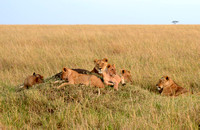
* (Photos 1 to 9): We found the nomadic "Breakaway Pride" of lions sleeping on a termite mound one morning before dawn. They are called this because this group of mothers and cubs literally broke away from a larger pride and went on their own -- without being accompanied by any mature males. This is risky, because if they encounter another pride, the males will kill their cubs in order to sire their own offspring. During our encounter with them, one of the mothers was awakened by a hyena. As it approached, she watched guardedly and circled the cubs. When it got near, the cubs woke up as well, and watched closely as it passed by. After they were all awake and the hyena had gone, they walked across a large expanse. During this movement, they accidentally stumbled across (and woke) females of the Rekero Pride, who were sleeping in long grass less than 100 meters away. They climbed on another termite mound, and there was a tense stare-down between the females of both prides. This lasted about 10 minutes. At this point, there was high risk for a fight. Fortunately for the Breakaway females, the Rekero male (known by the locals at "Lipstick") was not on the scene. We found him a bit later, sleeping nearby. If he had been awake and seen the Breakaway females this close, there would have been trouble. As it was, one by one, members of the Breakaway pride slinked away, without incident. The cubs went first, with mother being the last to leave the termite mound.
* (Photo 10): This is Lipstick, the Rekero Pride male, sleeping nearby.
* (Photos 11 to 17): We had ringside seats to a vicious battle between two large, rutting male impalas. Winners of such battles are awarded breeding rights with the herd females. Losers are often forced to leave the herd, and sometimes die from wounds acquired during the fight. In this case, there was a herd of about 30 females nearby -- so it was a worthy cause! Once the battle began, other male impalas came running over, and gathered round to try to break it up. They "yelled" at them to stop. Eventually things ended with one of fighters turning and running away. The winner gave chase, until they both disappeared over the horizon.
* (Photos 18 to 22): We saw a serval! Stacie will be the first to tell you of my fascination with African serval cats. They have the longest legs of any cat, relative to their body size. This gives them the ability to run 50 mph, and jump 12 feet straight up. They can literally pluck birds out of the air. Their large ears allow them to hear, find, and attack rodent prey burrowing underground. Their long necks allow them to see over tall grasses. They are such well-adapted, compact little hunting machines. Seeing one in the wild is very rare, as they are solitary and mostly nocturnal. So we were really lucky. I keep trying to convince Stacie to let me get one as a pet, but don't seem to be making much progress in this area. :-)
* (Photos 23 to 28): We watched a hunt involving a mother cheetah and her two nearly full-grown male cubs. As inexperienced hunters, the cubs went after anything that moved. First they stalked and chased a passing group of wildebeest and zebras. That hunt was short-lived and unsuccessful. Then they stalked a very large bushbuck -- much too large for them to to take down. But when they started chasing it, the movement scared a reedbuck out of the bush. The reedbuck is a much smaller animal, so they abandoned chasing the bushbuck, and took down the reedbuck instead. We didn't see the kill, but did see the aftermath and meal that followed.
* (Photos 29 and 30): We accompanied a lone mother lion as she searched for her pride. She had somehow become separated from them, probably during the previous night of hunting. You can see a small amount of blood on her upper chest, just below her left shoulder, which was probably a battle wound from her hunting activities.
* (Photos 31 to 42): We found her pride before she did. Just before dusk, we stumbled across them -- a very large pride with 9 cubs between the ages of 4 and 6 months! Because the heat of the day had already dissipated, the cubs were very playful. We sat for at least 30 minutes, watching them wrestle, run, jump, and attack one another. One of the cubs got quite mischievous with his mom, as you'll see in the photos! :-)
* (Photos 43 to 47): We have spent countless hours searching for leopards. They are just so elusive. Fortunately we were able to see two of them! We found the first one right after he had unsuccessfully hunted a warthog. It was late morning and getting hot, so he went up a tree to take a nap. We photographed him while he was getting settled on the branches directly above us. A few days later, we found another leopard. He had just caught a female impala, and dragged her up a tree. As he was preparing to eat, she started kicking. This caused him to lose his foothold, and both the leopard and his prey fell about 10 meters to the ground. The struggle then ended, and the leopard enjoyed his meal.
* (Photos 48 to 51): While sitting near a stream looking for a leopard, we noticed several bee eaters flying to and from the same tree branches, repeatedly. Upon closer inspection, we realized that they were literally living up to their name -- eating bees. They had a drill whereby they would fly from the branch, swoop around a nearby flowering bush, and catch bees that were buzzing around the blossoms. After catching the bees, they would return to the same tree branch, pulverize the bees by using their beaks to beat the bees on the branch, and then devour the pulverized bees. There was definitely a method to their madness!
Photos 52 to 103 are of various other sites and experiences we had while in the Masai Mara of Kenya during The Great Migration of 2013.
When you're ready to begin viewing, click on the "SLIDESHOW" button, found in the upper right hand corner of this screen.
Hope you enjoy the photos. :-)
Category:
Subcategory:
Subcategory Detail:
Keywords: